Slab Leak Detection in DeKalb, IL
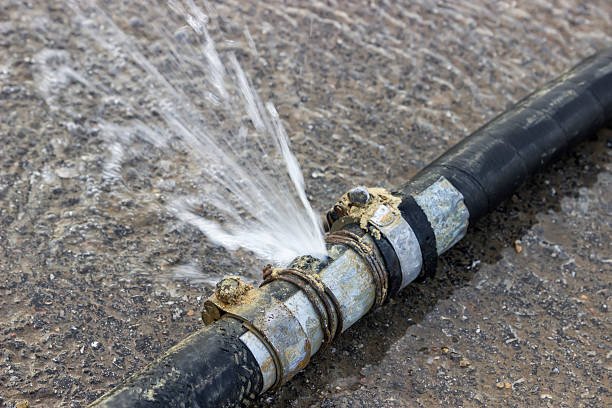
Most of northern Illinois builds on full basements, so homeowners here sometimes assume slab leaks are a Sun Belt problem. They are not. The water service line, hot-water recirculation loops, and the drain and waste piping for basement bathrooms and floor drains all run beneath the basement floor slab. Garage slabs, slab-on-grade additions, four-season rooms built over a poured pad, and most of the commercial buildings along Lincoln Highway and Sycamore Road are conventional slab construction.
When a line under that concrete fails, the water has nowhere useful to go. It travels along the underside of the slab, saturates the sub-base, and either pushes up through a crack, wicks into the slab edge and the bottom plate of a finished wall, or quietly runs into the drain tile and out through the sump — which is the worst case, because nothing ever looks wrong while your meter spins.
On this page
How a slab leak shows itself
A warm patch on the basement floor
Hot-water line leaks heat the concrete above them. If one spot of a cold basement floor is noticeably warm, mark it and stop walking on it.
A damp ring or white efflorescence
Water moving up through concrete leaves mineral deposits behind. A chalky white bloom on a floor slab is a long-running leak, not a one-time spill.
Sump pump cycling in dry weather
If your pump runs on a regular schedule during a dry stretch in July, something is feeding the drain tile. A failed under-slab supply line does exactly that.
Cracks that opened in the last year
Fresh hairline cracking that follows a line across the floor often follows the pipe trench beneath it, where the sub-base has washed out.
Buckled flooring or lifting tile
Vinyl plank, laminate and tile set on a slab respond quickly to moisture underneath, usually in a long narrow band rather than a round patch.
The meter runs with the house shut down
The definitive test, and the one that separates an under-slab leak from condensation or a foundation seepage problem.
Sewer smell with no visible source
A broken under-slab drain line lets sewer gas into the sub-base and up through slab cracks and floor drain surrounds.
Low hot-water pressure only
A leak on the hot side alone tends to show as pressure loss at hot taps while cold pressure stays normal.
Our under-slab locate process
1
Pressure test to prove which system is leaking
We isolate and hold pressure on the domestic supply, then on the hot loop separately. A drain line is tested with water or with smoke. Knowing whether you have a pressurized leak or a drain break changes everything about the repair, so we settle it first.
2
Ground microphone sweep on a grid
We lay out a grid across the suspect area and take amplified readings at intervals with a ground microphone tuned to the frequency band that escaping water produces. Sound through concrete attenuates predictably, so the decibel peak points at the pipe.
3
Line tracing to find the pipe run
There is no point marking a leak without knowing where the pipe actually goes. We trace metallic lines with an electromagnetic locator, and non-metallic lines with a sonde pushed through the pipe, so the X we mark sits on a pipe rather than in open fill.
4
Tracer gas for quiet leaks under concrete
Small leaks in PEX and poly under a slab can be nearly silent. Hydrogen-nitrogen tracer gas is lighter than air, passes through concrete and finds its way up to a sensitive detector at the surface. This is the method that solves the cases acoustics cannot.
5
Thermal confirmation
An infrared camera reads the surface temperature differential a hot-water leak creates in a slab. It is a confirming method rather than a primary one, but when it agrees with the acoustic peak, confidence is high.
6
Mark, photograph and quote the repair
You get a marked location, the depth we expect, the pipe material, and two or three honest repair paths with prices before anybody touches a hammer drill.
Three ways to repair a slab leak, and when each one makes sense
Spot repair through the slab
We saw-cut and remove a small section of concrete over the marked leak, excavate the sub-base, cut out the failed section and replace it, pressure test, then backfill and patch the concrete. This is the cheapest option and the right one when the pipe is otherwise sound and the leak is a single mechanical failure — a nicked line, a bad solder joint, a rock bearing on the pipe.
Re-route above the slab
Instead of chasing a pipe under concrete, we abandon the under-slab section and run a new line overhead through the joist bays or along a wall, insulated and supported to code. In a basement with an unfinished ceiling this is often faster and cheaper than breaking the floor, and it eliminates the section of pipe that failed rather than repairing it.
Repipe the branch or the house
If we find a second pinhole while repairing the first, the pipe is telling you something. When a copper system has begun failing from general corrosion rather than a single defect, replacing one fitting buys a few months. A branch repipe in PEX or type L copper is the durable answer, and it can usually be staged room by room.
Be careful with sealant "fixes"
Products injected into a system to seal under-slab leaks can clog aerators, cartridges and appliance valves, and they rarely hold on a pressurized line. We do not use them on potable water systems, and we would want to inspect the whole system before anyone else did.
What it is like when we work on your basement floor
Concrete cutting is loud and dusty, so we manage both. We use dust-controlled saws, seal off the work area in plastic, run negative air where the basement is finished, and lay protection across the path from the door. Typical spot repairs take most of a day: cut and excavate in the morning, plumbing repair and test by early afternoon, patch before we leave. The concrete patch is troweled flush; if you intend to re-cover the floor, we can leave it ready for tile or flooring rather than finished smooth.
If your basement is finished — and many DeKalb basements built in the 2000s in Devonaire Farms, Heartland Fields and Bridges of Rivermist are — we will always price a re-route beside a slab repair, because saving the finished floor is frequently worth more than the plumbing difference.
Common questions
Yes, though the wording differs from the southern states. Here the leak is almost always under a basement floor slab, a garage slab, or a slab-on-grade addition or commercial building rather than under the whole house. The water service line, hot-water recirculation piping, and the drain and waste lines for basement plumbing all pass under concrete, and any of them can fail.
More than people expect. A pinhole on a pressurized line running at typical municipal pressure can lose thousands of gallons a month while producing nothing more visible than a slightly damp floor. If the water is finding your drain tile and leaving through the sump, there may be no visible sign at all until the bill arrives.
It can undermine it. Water running along the underside of a slab washes fines out of the sub-base and creates voids. In DeKalb's clay-heavy glacial till, saturated soil also swells and then shrinks, which stresses footings and shows up as new cracking. It is one of the reasons we treat under-slab leaks as time-sensitive rather than something to watch for a season.
Illinois policies commonly cover the resulting water damage and the cost to access the pipe, while excluding the failed pipe itself and any damage attributed to gradual seepage. Coverage turns on documentation and on how sudden the failure was, so we photograph everything and describe the failure mechanism in writing. Check your own policy language and talk to your agent early.
On a pressurized line under a basement slab we generally mark within about a foot, often closer. Accuracy drops with depth, with heavy reinforcement, with very slow leaks, and when a leak is running along the outside of the pipe before it surfaces. We tell you the confidence level before you commit to cutting, rather than after.
Yes. Acoustic readings work through carpet, vinyl and engineered flooring, and tracer gas passes through slab and floor covering. If the finished surface is the concern, that is an argument for the re-route repair option rather than for skipping the locate.
Related leak services
A water meter that keeps ticking with every tap shut off means water is going somewhere. We find exactly where…
A wet basement floor has four possible causes and four completely different fixes. Paying for the wrong one is…
The line between your meter and your house is your responsibility, it is buried below the frost line, and it i…
Finding the leak is half the work. The other half is choosing a repair that lasts longer than the next winter.…
Think you have a leak? Call and we will find it today.
Same-day appointments across DeKalb and next-door response for active flooding. No digging or demolition until we know exactly where the leak is.
Leak line, answered 24 hours
(815) 849-0091Alpha Leak Fix Pros
1600 E Lincoln Hwy Ste D, DeKalb, IL 60115
One call does it. We work out what is likely wrong on the phone, quote before we come out, and book you in on the same call.